CPM(Critical Particle Metallurgy) taps have become increasingly important in the field of high-precision machining due to their excellent wear resistance, thermal stability, and long service life. Particularly when cutting difficult-to-machine materials, they provide outstanding performance, reduce production costs, and improve production efficiency. For users requiring high precision and durability, CPM taps are undoubtedly an ideal choice.
1. What are CPM Taps?
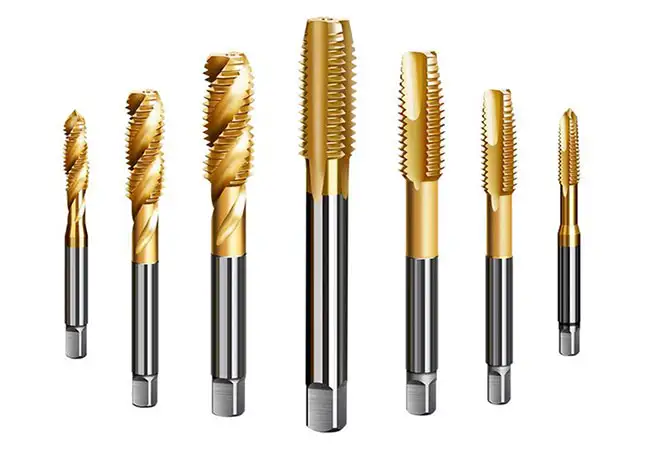
CPM taps are cutting tools made using Critical Particle Metallurgy (CPM) technology, offering extremely high wear resistance, strength, and thermal stability. Compared to traditional High-Speed Steel (HSS) taps, CPM taps have a more uniform material structure, showing better performance when machining harder and more difficult-to-cut materials. These taps are typically used in environments that require long periods of stable operation, high precision, and high-temperature resistance, such as automotive manufacturing, aerospace, and mold processing industries.
2. Raw Materials and Manufacturing Process of Taps
2.1 Raw Materials of CPM Taps
The raw materials used for CPM taps are generally high-quality powder steels composed of various alloying elements. These materials need to have the following characteristics:
- High Hardness Materials: Typically, the core material of CPM taps is made from alloy steel (such as HSS) or advanced powder steel alloys (e.g., CPM 10V, CPM S30V). These materials contain elements like chromium (Cr), molybdenum (Mo), tungsten (W), and vanadium (V), which help improve the metal's hardness, wear resistance, and thermal stability.
- Powder Metallurgy Steel Powder: Unlike traditional cast steel or forged steel, CPM taps use powder metallurgy steel powders. These powders are finely screened and mixed to ensure uniform distribution of alloy components, avoiding issues like uneven composition or large grain size that may occur in conventional cast steel. Powder steel offers higher density and uniformity, ensuring the tool performs more stably during work.
- Alloy Composition: The elements in alloy steel (such as chromium, molybdenum, tungsten, vanadium) improve hardness, corrosion resistance, wear resistance, and thermal stability. Specifically:
- Chromium (Cr): Enhances steel hardness and corrosion resistance.
- Molybdenum (Mo): Improves the steel's high-temperature resistance, maintaining hardness at elevated temperatures.
- Tungsten (W): Increases the steel's thermal hardness and wear resistance.
- Vanadium (V): Enhances steel's fatigue resistance and wear resistance.
2.2 Powder Metallurgy Manufacturing Process
The core manufacturing process of CPM taps is powder metallurgy. The main advantage of this process is that it ensures high uniformity in the tool material without sacrificing strength and toughness. The process includes the following key steps:
- Powder Preparation: First, metal powders containing different alloying elements are mixed. These powders are proportionally blended to ensure uniform distribution of each element in the final alloy. The powders are carefully screened to meet specific standards for particle size and chemical composition.
- Powder Mixing: After mixing, lubricants may be added to facilitate the subsequent pressing and sintering processes. This stage is critical, as the uniformity of the alloy powder mixture directly affects the performance of the final product.
- Pressing and Forming: The mixed metal powders are placed into molds and pressed under high pressure to form a preliminary shape. During this process, the powder particles bond together, increasing the density of the material.
- Sintering: The pressed powder material is heated to a high temperature (usually between 1000°C and 1300°C) in a sintering furnace. This process allows for metal diffusion between powder particles, resulting in a denser and stronger material. The control of temperature and time during sintering is crucial, as it directly determines the hardness, strength, and toughness of the final material.
- Heat Treatment: Although sintered material already has some hardness and strength, heat treatment (such as quenching and tempering) is performed to further enhance performance. Heat treatment makes the tool more resilient at high temperatures, improving wear resistance and thermal stability.
- Finishing: After sintering and heat treatment, the material undergoes finishing processes, including cutting, grinding, and polishing, to achieve the final shape, dimensions, and surface quality. This ensures that the CPM tap has superior cutting sharpness and surface finish.
- Coating (Optional): To further enhance wear resistance, many manufacturers apply coatings such as TiN (Titanium Nitride) or TiAlN (Titanium Aluminum Nitride). These coatings improve the hardness, corrosion resistance, and anti-adhesion properties of the tap, extending its service life.
3. Advantages of Powder Metallurgy Technology
- High Density and Uniformity: Powder metallurgy ensures that metal powder particles are evenly distributed, avoiding problems like uneven structure in traditional casting. This uniform microstructure allows for stable performance during cutting and reduces tool wear.
- Improved Hardness and Wear Resistance: By precisely controlling the alloy composition of the powders, higher hardness and wear resistance can be achieved. CPM taps maintain sharpness for a longer period, especially when cutting hard materials, outperforming traditional taps.
- High Heat Resistance: Powder metallurgy can create tools with high heat resistance and anti-deformation capabilities. This is essential for operations where high temperatures are generated during cutting, as traditional tools may degrade in performance under such conditions.
4. Performance of CPM Taps
CPM taps processed through the aforementioned methods perform exceptionally in the following aspects:
- High-Temperature Resistance: Due to the alloy composition and powder metallurgy process, CPM taps can work at temperatures up to 800°C or higher without degrading performance.
- High Wear Resistance: Compared to traditional HSS taps, CPM taps exhibit slower wear when machining harder materials (such as stainless steel, titanium alloys, etc.), resulting in a longer service life.
- Lower Cutting Forces: The uniformity of powder metallurgy ensures that cutting forces are evenly distributed during work, reducing vibrations and tool damage during machining.
5. Features of CPM Taps
5.1 Wear Resistance
One of the major advantages of CPM taps is their exceptional wear resistance. Due to the unique manufacturing process, CPM taps have greater hardness than standard taps, especially when machining hard metals. This means CPM taps last much longer during prolonged use and are less prone to damage.
5.2 Better Thermal Stability
During high-speed cutting, the tool temperature rises rapidly, and traditional taps may lose hardness due to heat. CPM taps, however, remain more stable and can withstand higher temperatures without performance degradation. This is particularly important in environments requiring long-term efficient operations.
5.3 Suitable for More Materials
CPM taps are not only suitable for standard steel but also for more difficult-to-machine materials like stainless steel and titanium alloys. This makes them particularly popular in industries such as aerospace, automotive, and mold manufacturing.
5.4 Longer Service Life
Although CPM taps may be more expensive than standard taps, their durability and efficiency result in cost savings over the long term. Tools are less likely to break, reducing the frequency of replacements and improving overall work efficiency.
5.5 Strong Corrosion Resistance
Due to their special alloy composition, CPM taps can resist corrosion from environmental factors such as moisture or acidic gases. This is especially important in industries requiring corrosion resistance, such as chemical and food processing industries.
5.6 Suitable for High-Precision Machining
CPM taps maintain high precision and are less likely to deviate, making them ideal for high-precision tasks where tight dimensional control is essential.
6. Conclusion
The manufacturing process of CPM taps combines powder metallurgy technology with high-performance alloy materials, providing exceptional wear resistance, high-temperature resistance, and a longer service life. These advantages make CPM taps unmatched in high-precision and high-demand machining environments.

 We like to do design according to all the customers' requirements, or offer them our new designs. With strong OEM/ODM capabilities, we can fill your sourcing demands.